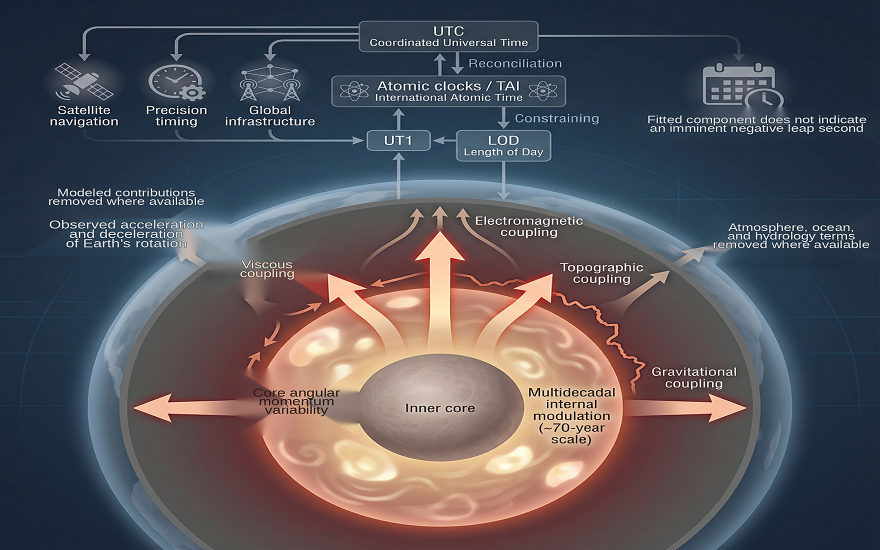
 NTSC Research Team Confirm an Approximately 70-year Core-related Modulation of Earth Rotation
Recently, a research team from the National Time Service Center (NTSC) of the Chinese Academy of Sciences (CAS) published a research paper in Earth, Planets and Space titled "An approximately 70-year core-related modulation of Earth rotation and its implications for the leap second".
10 10, 2026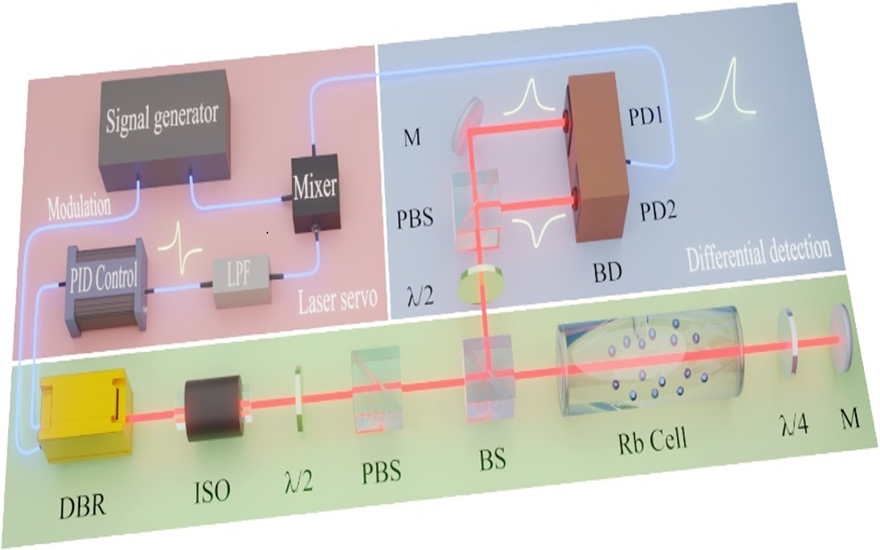 NTSC Researchers Propose "Full Differential Spectroscopy" for Quantum Precision Measurement
Researchers at the National Time Service Center (CAS) of the Chinese Academy of Sciences (CAS), in collaboration with the Suzhou Institute of Nano-Tech and Nano-Bionics (SINANO) of the Chinese Academy of Sciences, recently proposed and demonstrated a "full differential spectroscopy" (FDS) method, providing a new technical approach for miniaturized optical frequency standards.
09 24, 2026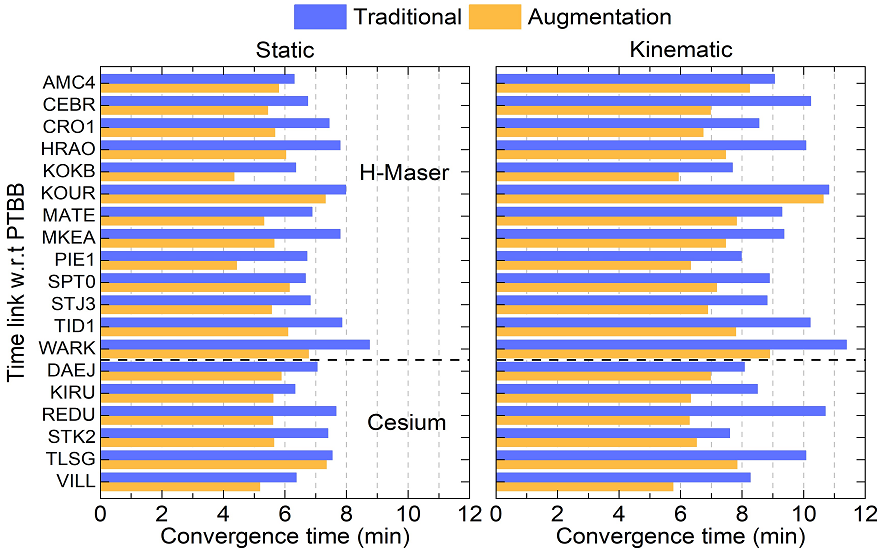 Real-time PPP Time Transfer Can be Improved Using Predicted Tropospheric Products
Recently, a research team from the National Time Service Center (NTSC), Chinese Academy of Sciences, proposed a novel real-time Precise Point Positioning (PPP) time transfer method augmented with predicted tropospheric products derived from the Global Forecast System (GFS). The proposed approach significantly improves the convergence speed, time link precision, and short-term stability of real-time PPP time transfer, providing a new solution for high-precision time synchronization applications.
09 01, 2026