 Print
Print Recently, a research team from the National Time Service Center (NTSC) of the Chinese Academy of Sciences (CAS) published a research paper in Earth, Planets and Space titled "An approximately 70-year core-related modulation of Earth rotation and its implications for the leap second".
By comparing the length-of-day (LOD) residuals after removing tides, surface fluids, and long-term trends with the core angular momentum (CAM) equivalent length-of-day inferred from the geomagnetic field, the study found that the two exhibit a modulation signal on an approximately 70-year scale over their common interval from 1883 to 2022, providing a new geophysical context for understanding low-frequency variations in Earth's rotation and for discussions on the leap second.
Coordinated Universal Time (UTC) is kept close to UT1, which is based on Earth's rotation, by inserting leap seconds. Since the current leap second mechanism was implemented in 1972, 27 leap seconds have been inserted globally, all of them positive, with the most recent in 2017. In recent years, UT1-UTC changes have shown signs of acceleration in Earth's rotation. If this trend continues, it could in theory prompt consideration of a negative leap second. However, a negative leap second has never been implemented before and could bring operational risks to time transfer, satellite navigation, and timekeeping systems.
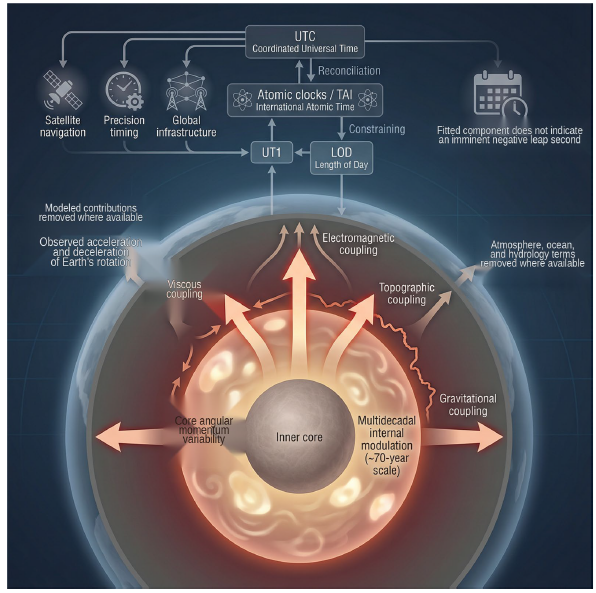
Dynamic mechanisms among Earth's spheres affect length-of-day changes and the leap second. (Imaged by NTSC)
Earth's rotation is slowed over the long term by tidal dissipation, with the length of day increasing at a rate of about 2.3 milliseconds per century. However, the recent observed acceleration in rotation is difficult to explain solely by tides, surface water, ice sheet mass migration, or changes in Earth's oblateness. This has prompted scientists to focus on Earth's deep interior, especially angular momentum exchange between the liquid outer core and the mantle.
In the study, the team used LOD and UT1 data including IERS C04 and LUNAR97-IERS. After removing the IERS2010 tidal model, the long-term tidal braking term, and the effective angular momentum contributions of the GFZ atmosphere, ocean, and hydrology, they constructed an LOD residual series. At the same time, they used the COV-OBS.x2 geomagnetic field model and the WebGeodyn tool to infer the CAM equivalent length-of-day. All multi-decadal harmonic fitting, spectral analysis, wavelet diagnosis, and LOD-CAM comparisons used the common interval from 1883 to 2022.
The results showed that the LOD residuals contain a harmonic component of about 69.7 years with an amplitude of about 2.87 milliseconds; the CAM equivalent length-of-day contains a component of about 71.8 years with an amplitude of about 1.94 milliseconds. The zero-lag correlation coefficient between the two series is 0.918; after an 11-year moving average, the correlation coefficient is 0.925; the lagged correlation reaches a broad peak when CAM leads LOD by about 1-3 years, with a maximum value of 0.932, corresponding to about 2 years.
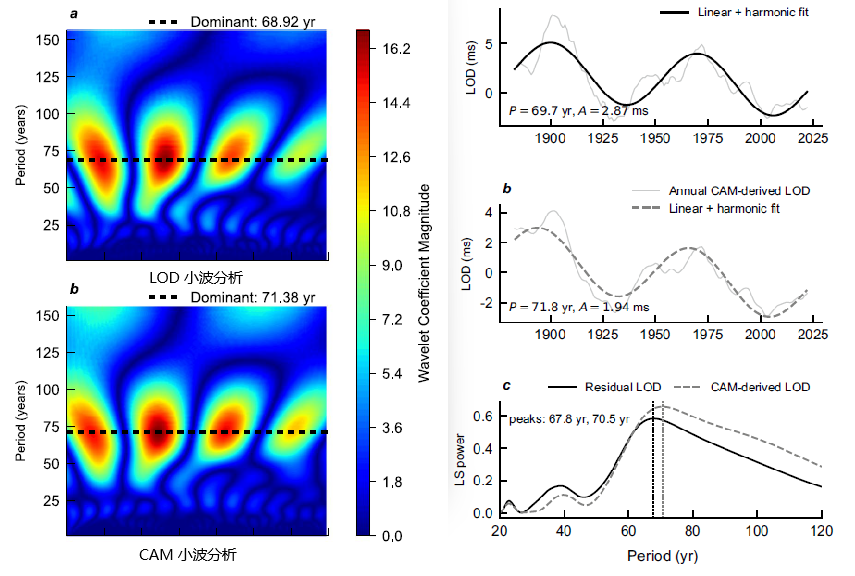
Both length-of-day changes (LOD) and Earth's liquid core angular momentum (CAM) exhibit a modulation signal of about 70 years, and from the phase of the signal, CAM leads LOD by 2 years. (Imaged by NTSC)
Under the fitted model, the next positive maximum of this 70-year component is extrapolated to be around 2040. Therefore, the study concludes that this component itself does not indicate that a shortening of the length of day sufficient to require a negative leap second will occur in the near future.
The study supports the important contribution of core-related angular momentum exchange to low-frequency variations in Earth's rotation, while noting that different core-mantle coupling mechanisms cannot yet be uniquely distinguished. The study also has limitations: historical LOD data cover only about two complete 70-year cycles, effective angular momentum corrections are lacking before 1976, and CAM inversion depends on geomagnetic field model assumptions and regularization schemes. In the future, with the accumulation of observational data and improvements in deep interior inversion, related research is expected to further constrain the connections between deep Earth processes and Earth's rotation, UT1, and time standards.
The first author of the paper is Zhang Zewen of the National Time Service Center, and co-authors include Wu Yuanwei, Li Xishun, Yao Dang, Cheng Xuan, Yang Xuhai, Zhang Shougang. The research was funded by the Strategic Priority Research Program of the Chinese Academy of Sciences (XDB1070202).