 Print
Print The chip-scale atomic clocks (CSAC) based on coherent population trapping (CPT) is milestone achievement for the applications which require precise timekeeping while being sensitive to size, weight, power, and cost (SWAP+C), such as deep-space exploration, micro- and nano-satellite formation networking, mobile very-long-baseline interferometry (VLBI), underwater resource exploration.
On recent years, aiming to achieve better frequency stability and accuracy while maintaining portability, a new frequency standards employ optical transitions (≥100 THz) instead of microwave transitions (~10 GHz) has drawn worldwide attention and received substantial investment for its potential transformative applications.
For this issue, researchers at the National Time Service Center (NTSC) of the Chinese Academy of Sciences (CAS), in collaboration with the Suzhou Institute of Nano-Tech and Nano-Bionics (SINANO) of the Chinese Academy of Sciences, recently proposed and demonstrated a "full differential spectroscopy" (FDS) method, providing a new technical approach for miniaturized optical frequency standards.
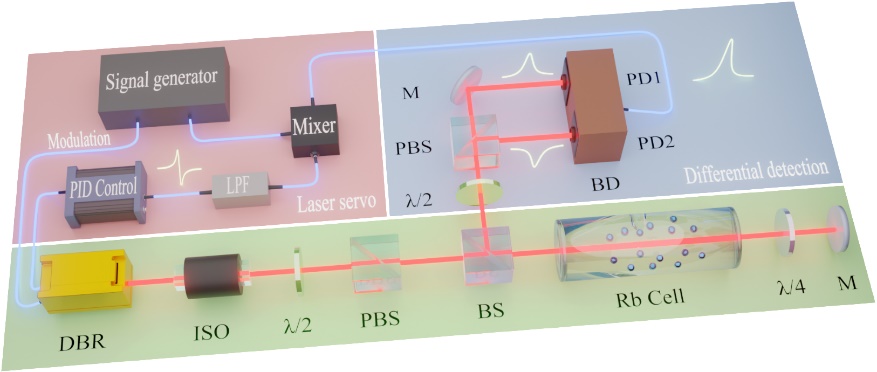
Figure 1. Schematic of the experimental setup for full differential spectroscopy. (Imaged by YANG Tenghui)
The method uses counter-propagating pump and probe beams interacting with an atomic ensemble (see Figure 1). The pump beam prepares the atomic ensemble partially into a quantum coherent dark state, while the two orthogonal polarization components of the counter-propagating probe beam undergo constructive or destructive interference with the previous dark state, simultaneously generating electromagnetically induced transparency (EIT) and absorption (EIA). The two signals share the same Doppler-broaden background but with opposite phases. With differential detection, a full differential spectrum is obtained (see Figure 2), in which the Doppler-broadened background and common-mode noise are substantially suppressed, while the Doppler-free resonant signal is maintained with enhanced amplitude. This yields a clock transition signal with a high signal-to-noise ratio, which is desired for high-performance optical frequency standards.
"This method avoids conventional complex setups and arrangements such as additional reference optical beam, a bichromatic laser, an external magnetic field, or fine polarization control. It also operates near room temperature and consumes laser power as low as 100 μW level, which makes it an ideal way to implement more compact or even chip-scale optical frequency standards," said YANG Tenghui, from NTSC.
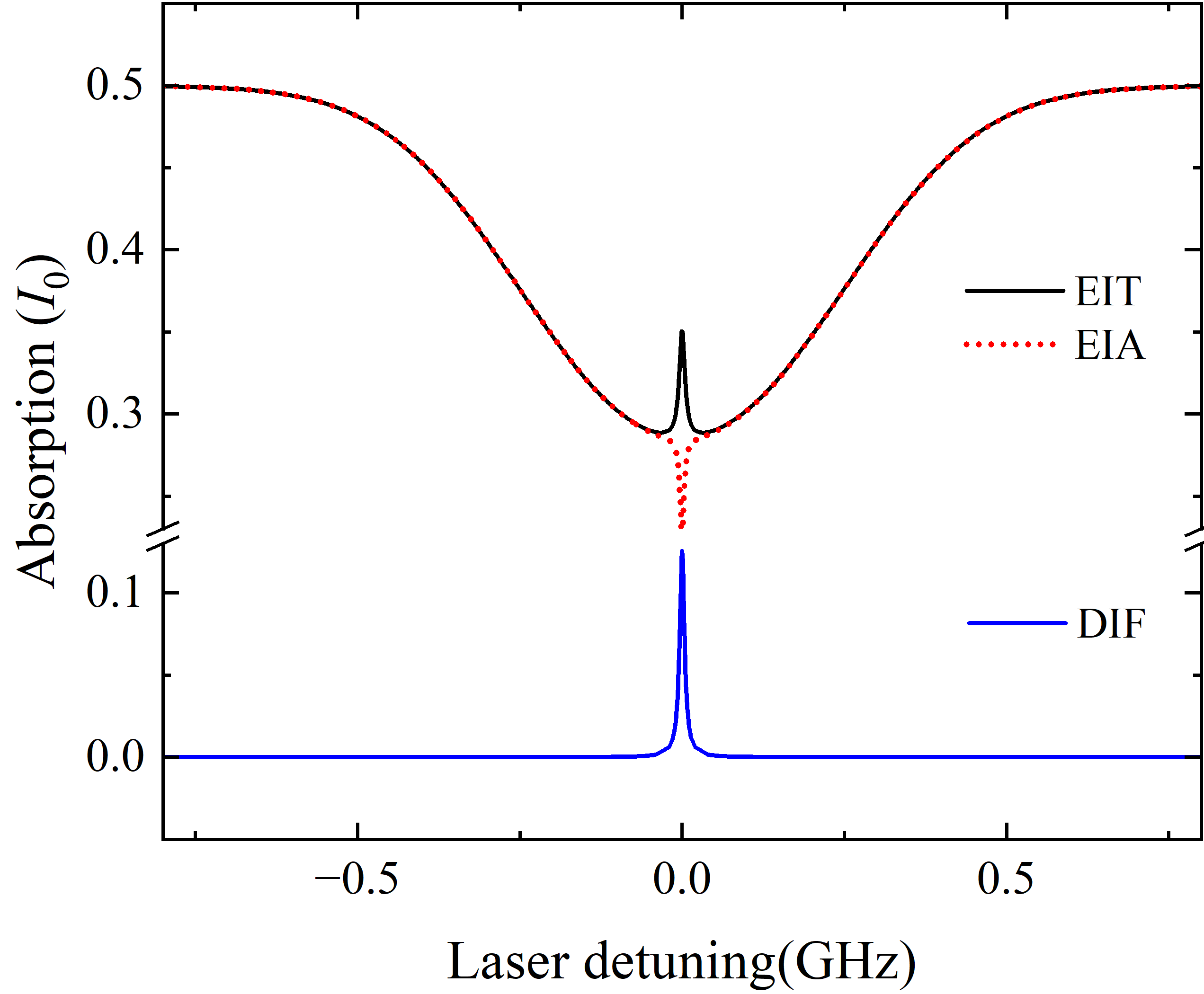
Figure 2. Theoretically calculated full differential spectrum, in which mirror-symmetric EIT and EIA are predicted, as well as the DIF signal with suppressed Doppler background and doubled signal amplitude. (Imaged by YANG Tenghui)
In the experiment, mirror-symmetric EIT/EIA signals are observed, and measured the differential (DIF) signal with increased amplitude and suppressed background agree well with theoretical prediction (see Figure 3(a)). What’s more, the experimental results also show that the noise of the differential signal is reduced by an order of magnitude compared with that of the EIT or EIA signals (see Figure 3(b)).
With the signal-to-noise ratio enhanced FDS signal, the team then implement a laser locking experiment. A distributed Bragg reflector (DBR) laser, which is firstly injection-locked by a miniature Fabry–Pérot cavity for pre-stabilization, is then locked to a rubidium vapor cell with the FDS method to realize a miniaturized optical frequency standard. It is shown that frequency stability reach to 1.2E-13 at 1s and stay below E-12 within 1000 s (see Figure 3(c)), these encouraging results reveal its potential for development of an even higher performance optical frequency standard.
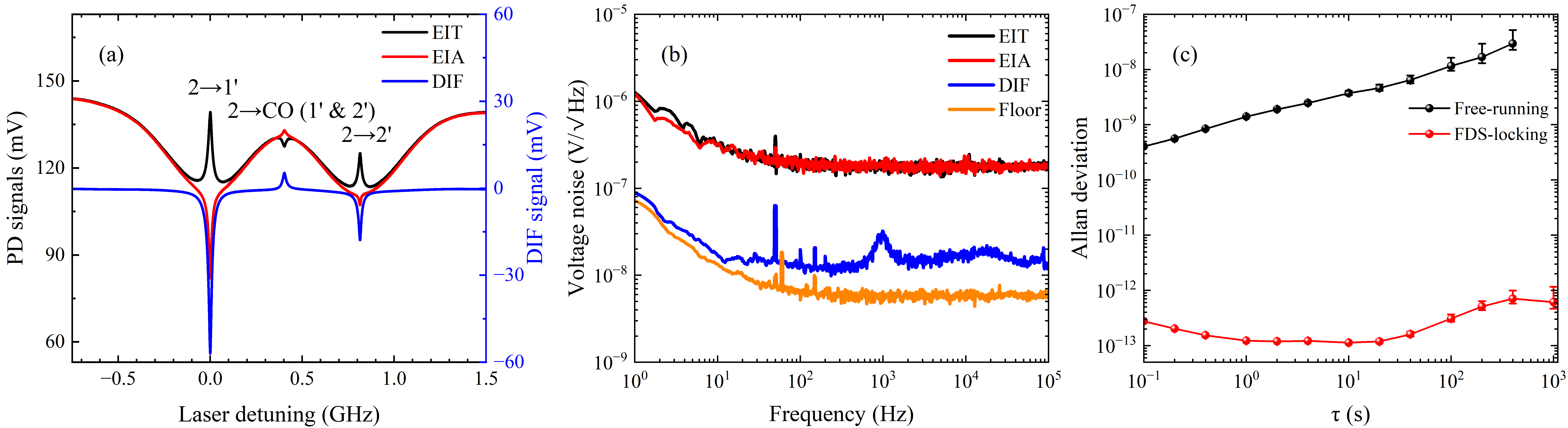
Figure 3. Experimental observations. (a) The FDS spectrum; (b) the noise spectra of the EIT, EIA, and DIF signals; (c) the frequency stability of FDS based the miniaturized optical frequency standard. (Imaged by YANG Tenghui)
"Besides the miniaturized and high-performance optical frequency standard demonstrated here, the FDS method may also find application in precision spectroscopy, quantum sensors, all-optical switch and coherent manipulation of quantum states, just name a few," said Prof. YUN Peter, team leader of this research group from NTSC.
The research results entitled "Full differential spectroscopy for high-stability vapor cell optical frequency reference" were published in Communications Physics on Sept 23, 2026.
Ph.D. student YANG Tenghui is the first author, and Professors YUN Peter and LIANG Wei are the co-corresponding authors. This work also received tremendous support from Professor BOUDOT Rodolphe of FEMTO-ST, France, and Dr. HAO Qiang of Nanyang Technological University, Singapore.