 Print
Print Recently, a research team from the National Time Service Center (NTSC), Chinese Academy of Sciences, proposed a novel real-time Precise Point Positioning (PPP) time transfer method augmented with predicted tropospheric products derived from the Global Forecast System (GFS). The proposed approach significantly improves the convergence speed, time link precision, and short-term stability of real-time PPP time transfer, providing a new solution for high-precision time synchronization applications.
This study was published in the international journal GPS Solutions on 27 July 2026 under the title "Improving real-time PPP time transfer with the augmentation of predicted tropospheric products".
Real-time PPP time transfer is a key technique for international time and frequency comparison and high-precision time synchronization. It has been widely applied in atomic clock comparisons, the maintenance of International Atomic Time (TAI), as well as navigation, telecommunications, and power systems. However, the strong correlation between the Zenith Wet Delay (ZWD) and receiver clock parameters often leads to slow convergence during the initialization stage, limiting the real-time performance of PPP time transfer. To address this issue, the research team utilized globally predicted atmospheric products from the GFS to derive predicted ZWDs and introduced them into the real-time PPP filter as virtual observations. This strategy effectively constrains tropospheric parameters and enhances the stability of receiver clock estimation.
To evaluate the proposed method, the researchers conducted experiments using one week of real GPS observations collected from 20 globally distributed GNSS stations, forming 19 time links. Experimental results demonstrate that, compared with the conventional real-time PPP approach, the proposed GFS ZWD augmentation reduces the average convergence time by 19.6% and 21.4% in the static and kinematic modes, respectively. Meanwhile, the time link precision is improved by 14.3% and 16.3%, and the time link stability is enhanced by approximately 10%-21%. The study further shows that the proposed augmentation is particularly effective during the initial convergence stage, while its contribution becomes limited after convergence. Therefore, the predicted tropospheric constraints are recommended primarily for the initialization phase of real-time PPP to further improve real-time service performance.
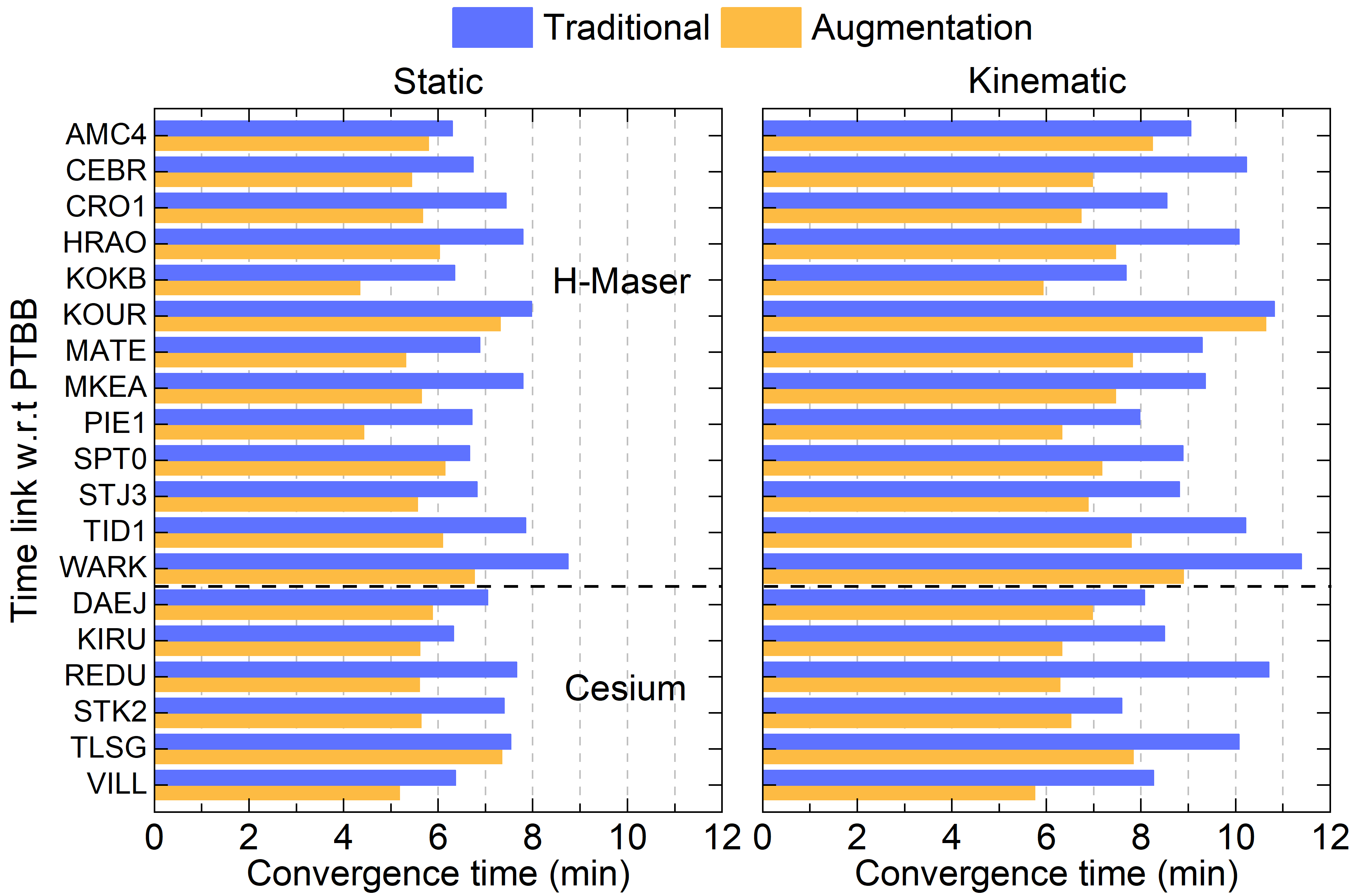
Comparison of convergence times for each time link in the static and kinematic modes (Image by NTSC).
The research team also investigated the influence of rainfall events and compared the proposed approach with empirical tropospheric models. The results indicate that, owing to its ability to better capture the spatiotemporal variations of atmospheric water vapor, the GFS-based numerical weather prediction products outperform conventional empirical models in terms of convergence time, time transfer precision, and stability, providing a promising solution for global high-precision real-time time synchronization.
This work further advances the development of real-time PPP time transfer technology and is expected to contribute to the establishment of high-precision time and frequency service systems, supporting future real-time applications such as intelligent transportation, autonomous driving, maritime navigation, and communication networks.