 Print
Print Recently, a collaborative research team from the National Time Service Center, Chinese Academy Of Sciences (NTSC) and the Nanjing Normal University proposed a real-time PPP time transfer model with tropospheric delay constraints based on Galileo HAS for improved time transfer accuracy. The proposed model can significantly improve the accuracy and stability of the time transfer results, demonstrating its potential for high-precision time transfer applications.
The study, entitled A real-time PPP time transfer model with tropospheric delay constraints based on Galileo HAS for improved time transfer accuracy was published in the academic journal Measurement Science and Technology.
The Galileo navigation system offers a free High Accuracy Service (Galileo HAS) to global users via the E6 signal and the Internet, enabling the broad application of real-time PPP time transfer. However, tropospheric delay is a major error source in real-time PPP time transfer and is highly correlated with clock offsets, which can ultimately limit the achievable time transfer accuracy.
To improve time transfer accuracy, researchers developed an innovative real-time PPP time transfer model with ZTD constraints based on Galileo HAS. The model extends the conventional PPP framework by incorporating high-precision ZTD estimates derived from the independently developed NRT-2D ray-tracing software as tropospheric constraints. An extended Kalman filter is employed for parameter estimation, with the ZTD weighting factor dynamically adjusted to effectively mitigate the adverse effects of the strong correlation between tropospheric delay and clock offset parameters.
The experimental results showed that the RMSE of NRT-2D ZTD and VIE-2D (a ray tracing software developed by the Vienna University of Technology) ZTD are 10.05 mm and 12.11 mm, respectively, which verifies that NRT-2D has higher accuracy in ZTD calculation. The tropospheric slant delay exhibits anisotropy that increases with decreasing elevation angle and is significantly stronger in summer and autumn than in spring and winter. Compared to conventional PPP time transfer models, the proposed model achieves accuracy improvements of up to 28.20% and 21.08% in GPS and Galileo-based PPP time transfer, respectively. Short-term frequency stability (1920 s) improvement rates reached as high as 40.27% and 52.99%.
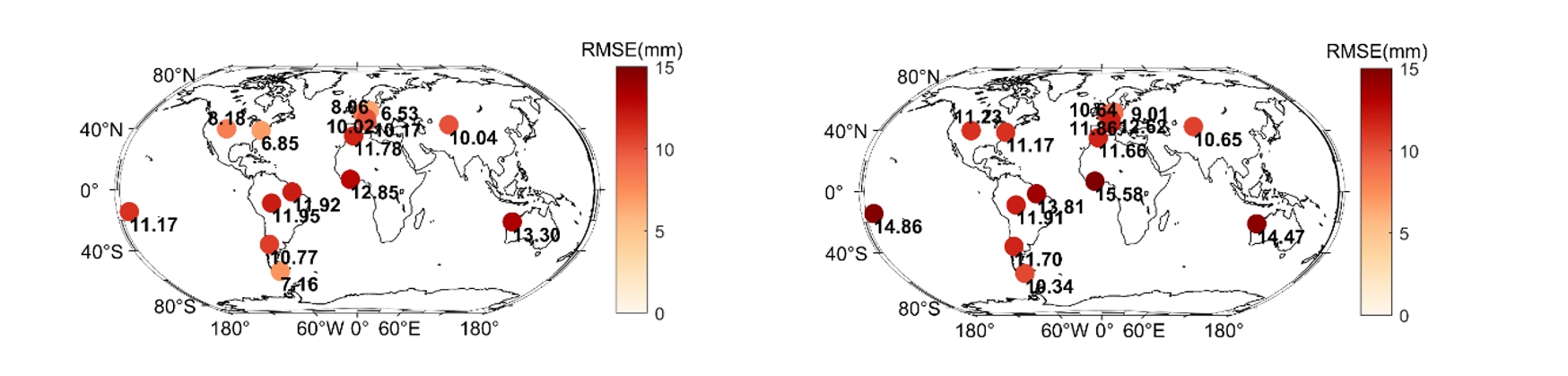
RMSE comparison of ZTD values obtained by two software packages (Left: NRT‑2D, Right: VIE-2D)
(Imaged by CHEN Xin)
According to the authors, tropospheric delay parameters are strongly correlated with receiver clock offset parameters in GNSS PPP based time transfer. Introducing high-precision tropospheric delay information as an external constraint can not only accelerate the convergence of real-time PPP and improve positioning accuracy, but also significantly enhance the precision of receiver clock offset estimation.
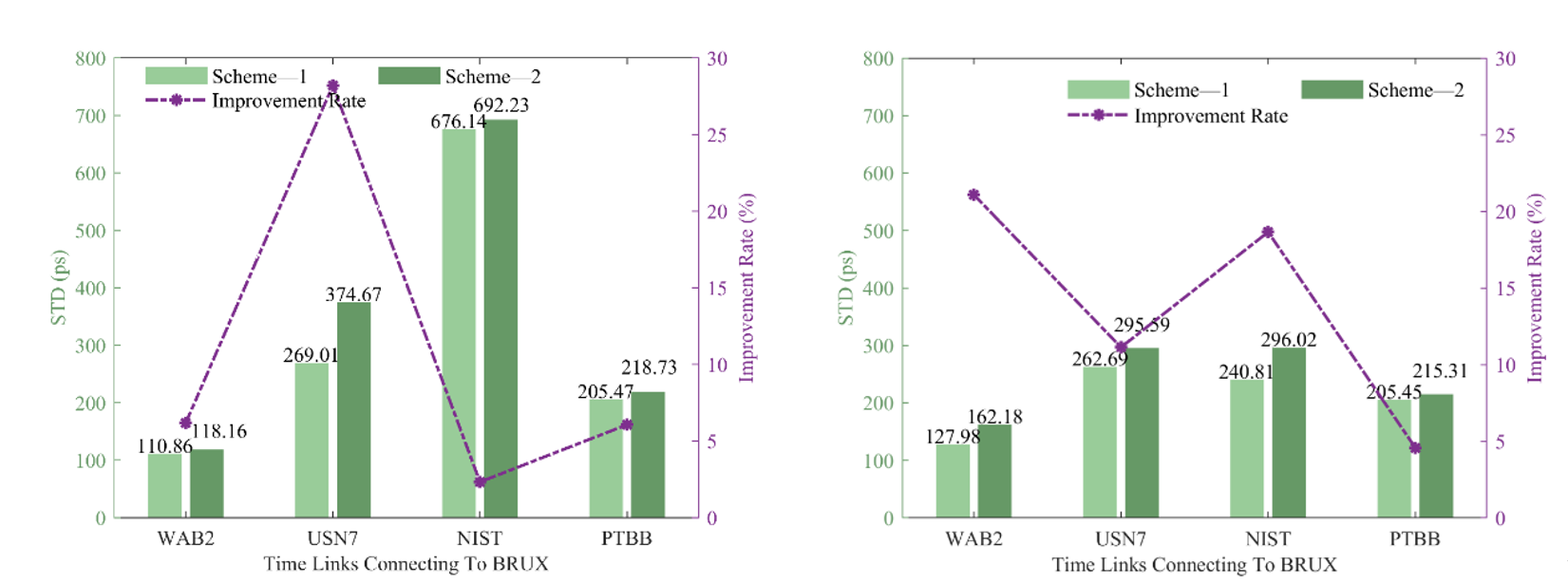
STD values and accuracy improvement rate for time transfer results (Left: GPS, Right: Galileo)
(Imaged by CHEN Xin)