 Print
Print Recently, the research team from the National Time Service Center (NTSC), Chinese Academy of Sciences (CAS), proposed a Wavelet–LSTM model for Low Earth Orbit (LEO) satellite clock prediction, improving the prediction accuracy of LEO satellite clocks over different prediction terms.
This research was published in the international journal "GPS Solutions" on June 22, 2026, entitled "LEO satellite clock prediction using deep learning: a Wavelet–LSTM method with Autoformer and LSTM comparisons".
LEO satellites have demonstrated great potential to enhance existing Global Navigation Satellite Systems (GNSS) for future Positioning, Navigation, and Timing (PNT) services. Owing to their lower orbital altitude, stronger signal power, and faster geometric variation, LEO satellites can contribute to improved satellite geometry and faster positioning convergence. However, high-accuracy LEO satellite clock prediction remains challenging. Compared with GNSS satellite clocks, LEO satellite clocks are affected by more complex orbital environments and systematic effects, resulting in nonlinear, time-varying, and multi-scale characteristics that are difficult to describe using a single deterministic model.
To address this issue, the research team investigated three deep-learning-based prediction models using real Sentinel-3B satellite clock estimates derived from onboard GNSS observations. The dataset contains 55 days of clock estimates with a 10-s sampling interval, including 44 days for training and 11 days for testing. The tested models include an improved Autoformer model with a pre-training and fine-tuning strategy, an optimized LSTM model, and the proposed Wavelet–LSTM model. Their performances were further compared with a traditional polynomial-periodic model.
The results show that the Wavelet–LSTM model achieves the best prediction performance among all tested models. In terms of average prediction accuracy, the model achieves approximately 0.05 ns for short-term predictions within 10 min and maintains an accuracy better than 0.3 ns for prediction intervals up to 60 min. Compared with the traditional polynomial-periodic model, the Wavelet–LSTM model improves the prediction accuracy by more than 60% for all considered prediction terms.
According to Prof. Kan Wang, the team leader of the LEO-augmented PNT research group at NTSC, this research demonstrates that multi-scale signal decomposition can effectively improve the capability of deep learning models in representing complex LEO satellite clock variations.
Research shows the comparison of prediction accuracy among different clock prediction models. The improved Autoformer and LSTM models do not consistently outperform the polynomial-periodic model, while the Wavelet–LSTM model achieves the lowest prediction errors for all prediction terms from 5 to 60 min.
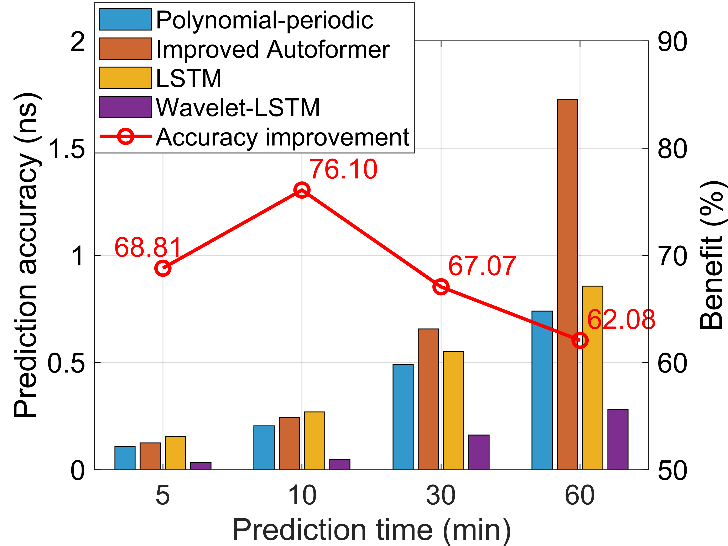
Prediction accuracy of four LEO satellite clock prediction models under different prediction terms. Image by Wang et al. 2026.
The study demonstrates that combining multi-scale signal decomposition with deep learning is effective for modeling complex LEO satellite clock variations and improving LEO satellite clock prediction accuracy.