 Print
Print On February 11, 2026, the International Bureau of Weights and Measures (BIPM) released the latest issue of its Time Bulletin (Circular T 457). The strontium optical lattice clock NTSC-Sr2, developed by the National Time Service Center (NTSC) of the Chinese Academy of Sciences, was used as a secondary representation of the second to calibrate International Atomic Time (TAI), marking the first time that an optical clock from China has contributed to steering TAI.
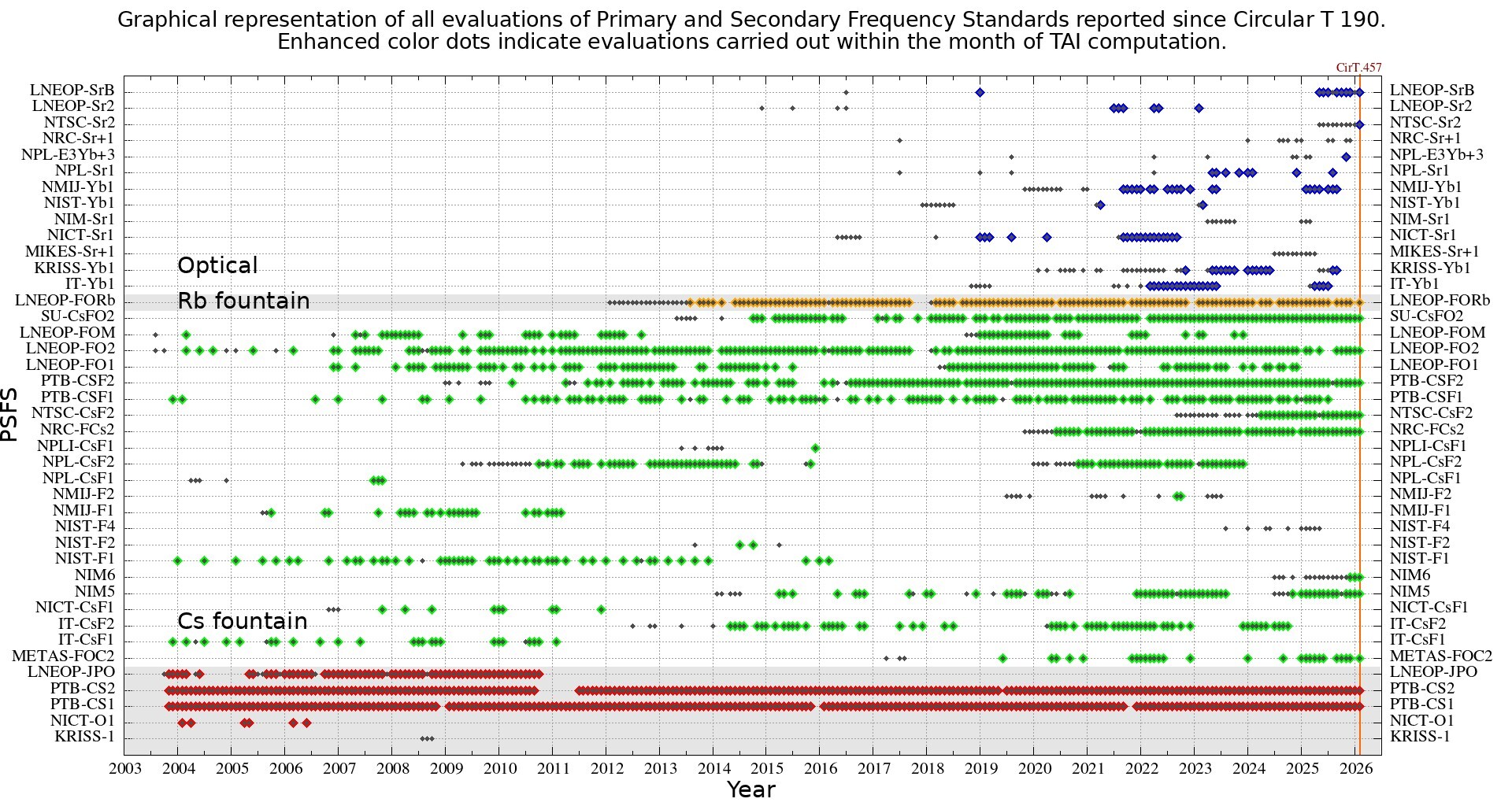
The figure on the BIPM website shows the participation of cesium fountain primary as primary standards, and rubidium fountain clocks and optical clocks as secondary standards, in the monthly calibration of TAI. Dark markers indicate clocks that provided data to BIPM, while bright colored markers indicate clocks that served that month as standards steering TAI. NTSC-Sr2 and NIM-Sr1 are the designations of the strontium optical clocks developed by NTSC and the National Institute of Metrology (NIM) of China, respectively.(Image by BIPM)
TAI is the atomic time scale computed by BIPM and published monthly as a reference for calibrating national or regional standard time scales to achieve worldwide time uniformity. It is formed by daily satellite-based comparisons of more than 400 continuously operating clocks from different countries and regions, whose data are combined with appropriate weighting to produce a stable free atomic time scale. This time scale is then calibrated using the current cesium fountain primary standards, as well as secondary standards such as rubidium fountain clocks and optical clocks, to obtain an atomic time scale that is both accurate and stable.
Under the current definition of the base unit of time—the "second"—the primary standards in use today are mainly cesium fountain clocks. The cesium fountain clocks developed by NTSC and NIM both serve as primary standards for calibrating TAI.
Optical clocks outperform cesium fountain clocks by more than two orders of magnitude. BIPM has established a roadmap for redefining the second based on optical clocks, with implementation planned after 2030, and has set stringent performance requirements for optical clocks. After more than a decade of dedicated research and development, the NTSC strontium optical clock NTSC-Sr2 has achieved a frequency stability and uncertainty both better than 2×10-18, reaching an internationally advanced level. It is China’s first optical clock whose performance meets the requirements for a future redefinition of the second.
BIPM has a dedicated expert group (WG-SPFS) responsible for evaluating and endorsing primary and secondary standards. Data provided by the strontium optical clocks of both NTSC and NIM have passed the group’s stringent review, and NTSC’s strontium optical clock achieved China’s first instance of steering TAI in January 2026. Prior to this, only a small number of countries—such as the United States, the United Kingdom, France, and Japan—had optical clocks used to steer TAI.
China’s first steering of TAI using an optical clock signifies that China has mastered the full chain of capabilities, from the independent development of high-performance optical clocks to their practical use in steering TAI. China’s optical-clock development and applications have entered the world’s “first tier,” representing a leap from being a participant to becoming a decision-maker within the international system for generating standard time. In addition, NTSC is responsible for developing the world’s first space optical clock, which has already been launched and deployed on the space station.
NTSC undertakes the task to generate, maintain and transmit the national standard of time (Beijing Time). Time-distribution services based on multiple methods support economic and social operations. At present, Beijing Time is independently controlled, and its accuracy ranks first internationally. Optical clocks not only serve the standard time-generation system—ensuring that Beijing Time remains autonomous and maintains world-leading performance—but will also be applied to many major engineering systems, improving performance and enabling new functionalities. They are strategic national resources.