 Print
Jean Bernard Leon Foucault (1819-1868)
Foucault is a renowned French experimental physicist.
He was highly erudite and made numerous inventions. He focused primarily on developing various scientific instruments, designing new experimental methods, and achieving precise measurements of physical quantities.
His most celebrated achievements include measuring the speed of light, devising the "Foucault pendulum" experiment, and proposing the theory of eddy currents.
In 1864, he was elected as a Fellow of the Royal Society and became an academician of both the Berlin Academy of Sciences and the St. Petersburg Academy of Sciences in the same year. He was elected as a member of the Paris Academy of Sciences in 1868. In recognition of his outstanding scientific contributions, a lunar crater has been named after him.
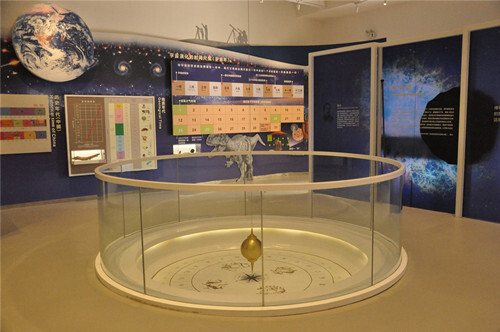
Foucault pendulum at the Time Science Museum of NTSC (Imaged by NTSC)
To demonstrate the Earth's rotation, Foucault conducted a successful pendulum experiment in 1851, after which the "Foucault pendulum" was named.
The experiment took place at the famous Panthéon in Paris. Foucault suspended a long simple pendulum beneath the highest dome of the Panthéon, with a length of 67 meters and a 28-kilogram bob, carefully designed to minimize friction at the suspension point.
Due to its heavy mass, the pendulum possessed significant inertia and momentum, allowing it to swing for extended periods. Because of its great length, the oscillation period was also long—each complete cycle lasted over 16 seconds.
During the experiment, people were astonished to see that the plane of oscillation slowly rotated clockwise, gradually shifting direction. Analysis of this phenomenon revealed that no external forces acted on the pendulum in the plane of its motion; according to the law of inertia, the spatial orientation of the swing should remain unchanged. This apparent change in direction reflects the Earth's own rotation.
The rotation period of the pendulum's oscillation plane depends on latitude: in Paris (48.5°N), one full rotation takes approximately 31 hours and 47 minutes, resulting in a deflection of about 11°20' per hour; in Beijing (40°N), a full rotation takes about 37 hours, or roughly 10° per hour; and in Xi'an (34°N), it takes around 40 hours, corresponding to approximately 9° per hour.